
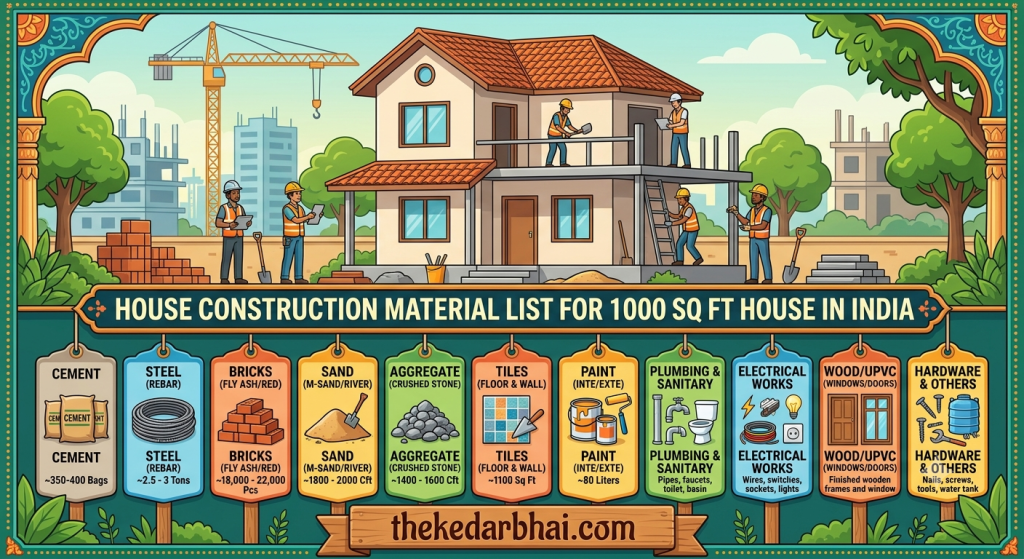
House Construction Material List for a 1000 Sq Ft House in India: Quantities, Checklist & Cost Planning
construction material list with quantity, material required for house construction, cement steel bricks required for 1000 sq ft house, house building materials list India, construction material calculator, house construction material cost.
Introduction: Before You Buy Materials for Your New House, Read This
Building a 1,000 sq ft house involves much more than purchasing cement, steel, bricks and sand. You also need aggregates, masonry materials, waterproofing products, pipes, electrical wires, flooring, paint, doors, windows, sanitary fittings and dozens of smaller items that can easily be missed during budgeting.
The problem starts when homeowners search online for a construction material list and find different answers on different websites. One article gives a cement quantity, another gives a much higher figure, and a third provides a total material cost without explaining what is included.
Which number should you trust?
The honest answer is that there is no single material quantity that is correct for every 1,000 sq ft house. The requirements depend on whether the house is single-storey or multi-storey, the structural design, the number and thickness of walls, the type of roof, the foundation conditions, the chosen materials and the level of finishing.
This guide helps you understand the full material list, prepare a preliminary budget, organise purchases and check whether a contractor’s estimate makes sense. It also explains where rough estimates are useful—and where you need quantities calculated from your actual drawings.
If you are planning a house in Uttar Pradesh, Bihar, Madhya Pradesh, Delhi NCR or another part of North India, use this as a starting point and replace illustrative rates with quotations from suppliers serving your location.
1. What Materials Are Required to Build a 1,000 Sq Ft House?
A typical house construction project can be divided into several stages. Each stage requires different materials, and the quantities must be coordinated with the design and construction method.
Foundation and plinth materials
The foundation transfers the building’s loads to the ground. Depending on the approved structural design and site conditions, materials may include cement, concrete aggregates, sand or other specified fine aggregate, reinforcement steel, binding wire, masonry units, backfill material and damp-proofing products.
The foundation cannot be estimated accurately from the house’s floor area alone. Soil conditions, column loads, foundation type and building height all matter. A soil investigation and structural design may be necessary depending on the project.
Structural construction materials
For an RCC-framed house, structural work may require cement or specified concrete, sand or approved fine aggregate, coarse aggregate, reinforcement steel, binding wire, formwork and related consumables.
The exact concrete mix and reinforcement requirements must follow the approved structural drawings and applicable specifications. Never use a generic online quantity to decide the steel reinforcement for columns, beams, foundations or slabs.
Wall construction materials
Walling materials may include fired clay bricks, fly-ash bricks, concrete blocks or AAC blocks, depending on the design and local availability.
You may also need masonry mortar, approved block adhesive where applicable, lintels, ties, mesh at specified junctions and materials for wall openings.
The choice of walling system affects more than the purchase price. It can influence wall thickness, dead load, plastering requirements, installation speed, thermal performance and the quantities of associated materials.
Plastering and finishing materials
Interior and exterior finishing can involve cement, plaster sand or specified plaster products, wall putty, primer, paint, waterproofing systems, floor tiles, wall tiles, adhesives, grout and sealants.
Finishing quantities are particularly sensitive to actual surface area and product specifications. For example, the amount of paint required depends on the wall area, surface condition, number of coats and the coverage stated for the selected product.
Plumbing and electrical materials
A complete materials list must also cover water supply, drainage and electrical installations. Depending on the approved layout, this can include pipes, fittings, valves, traps, drainage connections, electrical conduits, wires, distribution boards, protective devices, switches, sockets, earthing materials and light fittings.
These items are often overlooked when people calculate only cement, steel, sand and bricks. Include them in the project budget even if a separate specialist will supply and install them.
Doors, windows and sanitary fittings
Doors, frames, windows, glazing, hardware, locks, bathroom fixtures, taps, kitchen sinks and other fittings should be listed separately. Prices vary widely according to dimensions, material, brand and finish.
The practical lesson: Make a complete project materials schedule before treating any estimate as the budget for your entire house.
2. Material Quantity for a 1,000 Sq Ft House: What Determines the Numbers?
Before using an online estimate, identify the assumptions behind it.
Built-up area is not the same as plot area
A 1,000 sq ft plot does not necessarily accommodate a 1,000 sq ft house. Setbacks, access, open spaces and local building regulations may limit the permitted footprint.
Likewise, a 1,000 sq ft built-up area may refer to one floor or the combined built-up area of multiple floors. Those are different projects.
Always clarify whether your figure represents plot area, carpet area, covered area per floor or total built-up area.
Number of floors
A ground-floor-only house and a ground-plus-one house with the same area per floor have different structural requirements. Foundations, columns, beams, stairs and slabs must be designed for the actual building.
Do not simply multiply every material quantity by the number of floors. Some components are shared or have different dimensions, while others repeat. A proper estimate follows the actual design.
Wall thickness and layout
The number of bricks or blocks depends on the total wall area, wall thickness, unit dimensions, openings and the selected walling system.
A house with many small rooms and internal partitions may need a different quantity from a more open layout. A wall containing doors and windows also requires deductions for openings when calculating masonry quantities.
Structural design and site conditions
The soil, foundation system, spans, loads, column arrangement and structural design affect the quantities of concrete and steel. They cannot be reliably inferred from a front elevation or floor area alone.
Finishing specification
Basic, mid-range and premium homes can differ significantly in tiles, sanitaryware, electrical fittings, doors, windows, paint and other finishing items.
Two houses with identical built-up areas may therefore have very different total material budgets.
3. Complete Construction Material Checklist
Use this checklist to ensure that your estimate covers the entire project rather than only the most visible materials.
| Construction stage | Materials to include |
|---|---|
| Site preparation | Setting-out supplies, excavation-related requirements and approved filling materials |
| Foundation and plinth | Specified concrete, reinforcement, masonry and damp-proofing materials |
| RCC structure | Concrete constituents or approved concrete supply, reinforcement steel, binding wire and formwork |
| Masonry | Bricks or blocks, mortar materials or specified adhesive, lintel-related materials |
| Roofing and waterproofing | Approved waterproofing system, protective layers and drainage components as designed |
| Plastering | Specified plaster materials, corner beads or mesh where required |
| Flooring and tiling | Tiles or flooring material, adhesive or bedding materials, grout and skirting |
| Painting | Primer, putty where specified, interior paint and exterior-grade coating |
| Plumbing | Pipes, fittings, valves, traps, drainage components and sanitary connections |
| Electrical | Conduits, wires, boxes, switches, sockets, distribution board and protective devices |
| Doors and windows | Frames, shutters, glazing, locks, handles and other hardware |
| Bathrooms and kitchen | Sanitaryware, taps, sinks, accessories and installation consumables |
| Exterior works | Boundary wall, gate, paving, drainage and façade finishes, if included |
| Completion and handover | Sealants, minor finishing materials, touch-up paint and specified testing items |
The list is a planning framework, not a statement that every item applies to every house. Your final schedule should reflect the drawings, selected specifications and scope of work.
4. Cement, Steel, Sand, Aggregate and Bricks: How to Estimate Them
These five material categories often dominate preliminary discussions about construction quantities. They should be estimated separately, with assumptions clearly recorded.
Cement
Cement may be used in concrete, masonry mortar, plastering, floor beds and other specified applications. The total depends on the concrete design, masonry area, mortar specifications, finishing scope and whether ready-mixed or other specified products are used.
Ask the estimator to separate the major applications rather than giving you one unexplained total. Check the cement type and grade against the project specifications.
For storage, keep bags protected from moisture, use a dry and suitable storage area, and manage deliveries so that material is not left unused on site for long periods.
Reinforcement steel
Steel requirements depend on the structural drawings and reinforcement schedule. Diameter, bar lengths, laps, bends, anchorage, cutting plans and wastage assumptions all affect the procurement quantity.
Your structural engineer’s drawings and bar bending schedule, where provided, are the appropriate basis for ordering reinforcement. An online kilograms-per-square-foot figure is not a substitute.
Record the specified grade, diameter, weight, supplier documentation and delivered quantity. Have the responsible site professional check the material against the approved specification.
Sand and other fine aggregates
Fine aggregate may be used in concrete, mortar and plastering, depending on the approved mix and product. The appropriate material can differ by application.
Clarify whether the estimate is measured in cubic feet, cubic metres, tonnes or another unit. Do not compare two quotations until the units and material specifications match.
Also confirm that the delivered material is suitable for the intended use and complies with the project’s requirements.
Coarse aggregate
Coarse aggregate is used in specified concrete applications. The required size and grading depend on the work and design.
Ask for the aggregate type, grading, quantity and delivery unit. Record the delivered loads rather than relying only on a verbal description of truck capacity.
Bricks or blocks
Masonry quantities should be based on wall dimensions, unit size, wall thickness, openings and mortar or adhesive specifications.
For a wall-based estimate, calculate the net wall area, convert it to the required wall volume or unit count using the actual product dimensions, and account for openings and an appropriate allowance based on the project and product.
Do not assume the same number of bricks applies to every 1,000 sq ft house. The layout and wall system can materially change the answer.
5. How to Calculate Material Quantities from Your House Plan
A reliable quantity estimate starts with the drawings and breaks the project into measurable components.
Step 1: Establish the measurement basis
Record the plot area, built-up area per floor, number of floors, floor heights and the relevant dimensions from the approved drawings.
Check whether balconies, staircases, covered areas and other spaces are included in the stated area.
Step 2: Measure the work item by item
For example, wall masonry can be estimated from the dimensions of individual wall sections, after deducting door and window openings. Flooring can be estimated from the floor area of each room, adjusted for the selected tile size, layout and an appropriate cutting allowance.
Painting should be based on the surfaces to be painted and the coverage and coat requirements of the chosen product.
Step 3: Follow the structural design for RCC quantities
Concrete volumes are calculated from the actual dimensions of the structural elements. Reinforcement is calculated from the structural details and bar schedule.
Do not choose foundation dimensions, beam sizes, column sizes or reinforcement from an internet formula. Those are engineering decisions.
Step 4: Use product-specific coverage rates
For paints, adhesives, waterproofing and similar products, use the manufacturer’s coverage data for the actual substrate and application method. Coverage can vary with surface preparation, thickness, absorption and number of coats.
Step 5: Add a justified allowance
Material loss can occur through cutting, breakage, spillage, handling and storage. The appropriate allowance depends on the material, installation method and site management.
Do not apply one arbitrary percentage to every material. A suitable allowance for tiles is not necessarily appropriate for reinforcement steel or cement.
Step 6: Cross-check the estimate
Compare the material schedule with the architectural drawings, structural drawings, specifications and contractor’s BOQ. Resolve discrepancies before placing large orders.
This process takes more care than multiplying the built-up area by a generic rule, but it provides a much stronger basis for procurement and cost control.
6. Construction Material Cost: How to Build a Realistic Budget
The material budget should be prepared using current local quotations and the quantities derived from your actual project.
A simple calculation for each item is:
Material cost = Estimated quantity × Quoted unit rate
For example, if a supplier quotes a particular material at ₹500 per unit and your verified estimate requires 100 units, the basic material amount is ₹50,000 before any additional charges or adjustments.
The example demonstrates the calculation only; ₹500 is not a current market price for any specific material.
For each item, confirm whether the quote includes applicable taxes, transport, unloading, handling, packaging, returns and any other charges. Clarify whether the price is for the exact grade, size and brand specified.
Separate materials from labour
A material-only estimate is not a complete construction budget. Labour, equipment, shuttering, installation, specialist services, transport and finishing may be quoted separately or bundled into a contractor’s rate.
Make sure the estimate clearly distinguishes material supply from labour and installation. Otherwise, the same work can be omitted from one quote or counted twice in another.
Use local supplier quotations
Rates vary with city, supplier, brand, availability, delivery distance, quantity and timing. A quotation for a project in Lucknow may not match a quotation for a project in a smaller town or another state.
For a meaningful comparison, request multiple quotations for the same material specification and delivery conditions.
Create a contingency without hiding uncertainty
Keep a separately identified contingency based on the project’s circumstances and the advice of your estimator. Do not use contingency as a substitute for missing quantities or unclear scope.
If the estimate is incomplete, mark the unpriced items and resolve them before treating the total as a dependable budget.
For a broader look at the overall project budget, read the relevant house-construction-cost guides on The Kedar Bhai. This article focuses on materials and should complement—not duplicate—the site’s wider construction-cost coverage.
7. How to Buy Construction Materials Without Losing Money
Purchasing well means controlling specifications, quantities, timing and delivery—not simply choosing the lowest rate.
Compare identical specifications
For cement, compare the specified product and pack size. For steel, compare grade, diameter, weight and documentation. For bricks or blocks, compare dimensions, product type and relevant quality requirements.
A cheaper quotation may refer to a different product or exclude delivery. Confirm the specification before deciding.
Order in phases where practical
Some materials need to be available early, while others should arrive closer to their use. Plan deliveries around the construction schedule and available storage.
Buying everything at once can tie up cash and expose materials to theft, moisture, damage or deterioration. Buying too late can delay work or increase transport costs. The right timing depends on the item and site conditions.
Check deliveries when they arrive
Maintain a delivery register that records the date, supplier, material, stated quantity, unit, vehicle or delivery reference, and any discrepancies.
For bagged goods, check counts and visible condition. For bulk materials, establish the agreed measurement method and delivery unit. For reinforcement, check the supplied sizes and documentation against the approved requirements.
Raise discrepancies promptly rather than waiting until the material has been consumed.
Store materials correctly
Cement must be kept dry. Steel should be handled and stored appropriately for the site and material condition. Bricks and blocks should be stacked safely. Tiles, fittings and electrical items should be protected from breakage, moisture and theft.
Good storage protects your investment and reduces the risk that damaged material will be installed.
Keep bills and records
Save quotations, invoices, delivery notes, test certificates where applicable and payment records. Reconcile the materials purchased with the quantities issued to the site and the work completed.
This record makes it easier to investigate shortages, duplicate purchases and unexplained changes in cost.
8. How to Check Your Contractor’s Material Estimate
Before accepting a quotation, ask the contractor to explain what is included and how the quantities were derived.
Start with the scope. Does the estimate include only the RCC structure, or does it also cover masonry, plastering, waterproofing, flooring, electrical work, plumbing and finishing?
Next, check the units. Cement may be quoted in bags, steel in kilograms or tonnes, sand in cubic feet or cubic metres, and tiles in square feet or square metres. Unit mismatches can make two quotations appear different even when the underlying quantities are similar.
Then compare the material specifications. Confirm the specified product, grade, dimensions, brand requirements where relevant, and whether transport and unloading are included.
Finally, compare the quantity schedule with the drawings and BOQ. Large discrepancies need an explanation before you approve procurement.
Watch out for these warning signs:
- A single total is provided without a clear scope.
- Major material quantities have no stated basis.
- Structural steel is being estimated without reference to structural drawings.
- The quotation leaves important finishing or installation work unspecified.
- Material brands or grades can be changed without an agreed approval process.
- Transport, unloading, wastage and taxes are unclear.
- The contractor cannot explain how the amount will be measured or reconciled.
Use The Kedar Bhai quotation-checking tool to help organise your comparison. It can support your review, but it cannot replace a qualified professional’s verification of structural quantities.
9. Common Material-Estimation Mistakes Homeowners Make
Using the wrong area
A plot area, carpet area and built-up area are not interchangeable. Make sure every calculation uses the correct area and states whether it refers to one floor or the whole building.
Treating an online thumb rule as an order quantity
Thumb rules can be useful for an initial conversation or rough budget. They cannot account for your exact wall dimensions, openings, spans, foundation design and finish specifications.
Use drawings and a BOQ for actual purchasing decisions.
Forgetting finishing materials
A budget that covers only cement, steel, sand and bricks will omit a large portion of the materials required to complete a home. Include plumbing, electrical work, waterproofing, flooring, paint, doors, windows and fittings.
Comparing different quotation scopes
One contractor may include transport and unloading while another excludes them. One may include material supply only, while another includes installation. Standardise the scope before comparing totals.
Ignoring storage and wastage
Materials can be lost through poor storage, breakage, theft, incorrect handling or unsuitable delivery timing. Plan storage and monitor site usage instead of assuming every purchased unit will be used productively.
Ordering structural materials without approved details
Foundation and reinforcement requirements must come from the project’s structural design. Do not use a generic per-square-foot figure to make engineering decisions.
Failing to update the estimate
Design revisions can change quantities. When a wall moves, a window changes size or a finish is upgraded, update the schedule and budget before the work proceeds.
10. A Practical Construction Material Planning Worksheet
Complete the following worksheet before requesting quotations. It helps you and your contractor work from the same assumptions.
| Planning detail | Information to record |
|---|---|
| Project location | City, town or village |
| Plot dimensions | Actual width and depth |
| Built-up area | Per floor and total |
| Number of floors | Ground floor only, G+1 or other |
| Structural system | As specified by the design professional |
| Walling material | Brick, AAC block, concrete block or other |
| Roof system | As specified in the approved design |
| Finish level | Basic, mid-range or premium |
| Plumbing and electrical scope | Included, excluded or separately quoted |
| Material delivery | Transport and unloading terms |
| Quantity source | Drawing, BOQ, supplier schedule or preliminary estimate |
| Quotation status | Requested, received, compared or approved |
Keep a separate schedule for each material, including its specification, quantity, unit, quoted rate, supplier, delivery charge and final amount.
This makes it easier to update the budget when prices change or the design is revised.
11. How The Kedar Bhai Can Help You Plan Material Purchases
Construction material decisions create several opportunities to save time and reduce confusion. The most useful next step is to move from general estimates to a documented project-specific material plan.
Explore The Kedar Bhai Tools for construction-planning resources and use the quotation-checking tool to help organise competing offers.
If you need help finding relevant providers, visit The Kedar Bhai Provider Directory. You can also submit a project request to describe your requirements, or browse material suppliers for the categories available on the site.
Suppliers and service providers can explore Register as a Provider/Vendor.
The objective is simple: make your material requirements clear, compare offers on a consistent basis and keep a record of what you purchase.
Frequently Asked Questions
1. What is the complete construction material list for a 1,000 sq ft house?
A complete list can include cement, reinforcement steel, sand or specified fine aggregates, coarse aggregates, bricks or blocks, mortar materials, waterproofing products, plastering materials, flooring, paint, pipes, fittings, electrical wires, conduits, doors, windows, sanitaryware and hardware. The exact list depends on the structural design, walling system, finish specifications and scope of work. Prepare the list from the project drawings and specifications rather than relying on a generic checklist alone.
2. How much cement is required for a 1,000 sq ft house?
There is no single reliable quantity for every 1,000 sq ft house. Cement requirements depend on the number of floors, structural system, concrete design, masonry area, plastering and flooring specifications. Published estimates can differ because their assumptions differ. For preliminary budgeting, use a clearly labelled estimate; for procurement, obtain quantities based on the drawings, BOQ and specified materials.
3. How much steel is needed for a 1,000 sq ft house?
The reinforcement quantity depends on the structural design, building height, spans, loads, foundation conditions and reinforcement details. A generic kilograms-per-square-foot figure cannot establish the correct quantity for your home. Use the structural drawings and bar bending schedule, where provided, and have the responsible engineer resolve discrepancies before ordering steel.
4. How many bricks are required for a 1,000 sq ft house?
The brick or block count depends on the net wall area, wall thickness, unit dimensions, openings and the chosen masonry system. A house with numerous internal partitions can require a different quantity from one with fewer walls. Estimate each wall from the actual floor plan, deduct openings as appropriate, and include a justified allowance for cutting and breakage.
5. What is the cost of construction materials for a 1,000 sq ft house in India?
The total depends on the quantities, location, material specifications, supplier rates, transport, finishing level and project scope. A material-only budget is different from a complete construction cost that includes labour and installation. Obtain current local quotations against a project-specific schedule and clearly identify items that remain unpriced. Avoid treating a generic internet figure as a guaranteed local price.
6. How can I calculate material quantities from a house plan?
Start with the approved architectural drawings and the structural drawings. Measure wall areas, floor areas and other applicable dimensions; calculate the quantities of the relevant work items; use product-specific coverage data for finishing materials; and follow the structural details for concrete and reinforcement. Record your assumptions, units and allowances. Have the estimate reviewed by the relevant professional before using it for actual procurement.
7. Is an online construction material calculator accurate?
A calculator can be useful for preliminary planning when its inputs and assumptions are appropriate. It cannot know your actual structural design, wall layout, soil conditions, product specifications or local construction rules unless those details are explicitly included. Treat calculator results as estimates, compare them with your project drawings and use a proper BOQ or professional take-off for purchasing decisions.
8. Should I buy all the construction materials at once?
Usually, the purchase schedule should follow the construction sequence, storage conditions, supplier lead times and available cash. Buying too early can create storage, damage and working-capital problems; buying too late can interrupt work. Plan deliveries in stages where practical, while securing any materials whose availability or lead time requires advance coordination.
9. How do I compare two construction material quotations?
Confirm that both quotations use the same product specifications, quantities, units, delivery location, transport and unloading terms, taxes and scope. Compare the itemised totals rather than only the headline price. Ask for clarification where one supplier has omitted a material or used a different unit. Keep a record of the final approved specifications and the supplier’s delivery commitments.
10. What is the difference between a material list and a BOQ?
A material list identifies the materials expected to be needed for a project. A bill of quantities generally provides a structured schedule of work items and measured quantities based on defined drawings and specifications, and may support tendering and cost comparison. The format and level of detail can vary by project. A simple online list is not automatically a complete BOQ, and a material list should not be used as a substitute for structural documentation.
11. Which construction materials should be checked most carefully on delivery?
Check all deliveries against their specifications and purchase documents. Pay particular attention to bag counts and condition for cement, sizes and documentation for reinforcement steel, the agreed unit and quantity for bulk aggregates, and the dimensions and visible quality of bricks or blocks. Store materials appropriately and record discrepancies promptly. Material acceptance and testing requirements should follow the project’s specifications and applicable standards.
12. Where can I find construction material suppliers in India?
Start by identifying the materials, specifications, quantities and delivery location for your project. Request quotations from suppliers who can serve that location, and compare the full delivered cost rather than only the quoted unit rate. You can explore The Kedar Bhai Material Suppliers directory for relevant listings and verify each supplier’s availability, product specifications and delivery terms directly.
Authoritative References and Further Reading
For actual construction decisions, consult the relevant project drawings, material specifications, applicable Indian Standards and qualified professionals.
- Bureau of Indian Standards: National Building Code of India — a reference for building-related requirements and professional coordination, subject to applicable local regulations.
- Bureau of Energy Efficiency: Energy Conservation Building Code resources — background on building performance and energy-related design considerations.
- Project-specific documentation: Approved architectural drawings, structural drawings, specifications, reinforcement schedules and the BOQ are the key references for quantities and procurement on an individual project.
Disclaimer: All quantity and cost estimates must be treated according to their stated assumptions. Do not use generic internet estimates to determine foundation dimensions, reinforcement design, concrete specifications or other safety-critical requirements. Have the relevant quantities and construction details verified for the actual site before ordering materials.